It is beyond the scope of this paper to subject each of the thirty variations to a detailed analysis. I will therefore stick to the division into groups of three and select one or two representative examples from the character variations, the virtuoso variations and the canons, which I will explain in more detail.
Earlier, I explained that the first variation in a group of three can generally be described as a character variation. Only the first and twenty-eighth variations are clear exceptions to this rule. “Character variation” means that Bach, relying exclusively on the bass structure of the aria, changes the character of the sarabande with great freedom. He has accordingly given some variations characteristic names: No. 7 “al tempo di Giga”, No. 10 “Fughetta”, No. 16 “Ouverture”, No. 22 “alla breve”, No. 25 “adagio”. With the exception of the G minor canon in the fifth (V 15), which concludes the first half in a calm manner and bears the tempo marking “andante”, Bach otherwise refrained from tempo markings and other characterisations. The remaining variations, which lead the groups of three, can easily be assigned characteristic names:[18] No. 4 “Springtanz” (leaping dance), No. 13 “verziertes Adagio” (ornate adagio), No. 19 “Ländler”[19]. In contrast to the virtuoso variations, which predominantly retain the 3/4 time of the sarabande, we find, as might be expected, all kinds of even and uneven half, quarter and eighth time signatures in the character variations.
The two-part French overture (V 16), which solemnly introduces the second half
of the variation
work[20],
is initially in  time, then, in the fugal section, in 3/8 time. We are amazed by the achievement
of writing a fugue over a fixed bass structure in such a way that the bass itself
participates in the contrapuntal action as Comes (T 23) and, in the second
development, as Dux (T 35). The variation is to be read in such a way that
two bars of the fugue correspond to one fundamental note of the bass line. The
deviations from the basic pattern are minor. In bar 37 (corresponding to the 27th
fundamental note), for example, G major is found instead of A minor. Bach
achieved this extensive conformity by using an order of voice entries that is more
freely handled in relation to fugue theory. Not only the fugue, but also the slow
first part is written contrapuntally. In the second bar, the bass imitates the
upper voice of bar 1, and free imitations characterise the entire
‘Grave’[21].
At the transition to the fast section, the sudden, upbeat entry of the fugue causes
a
bar to be lost, which Bach replaces at the end, marked by the change in the last bar.
The Overture and the Gigue are movements in which Bach incorporates elements of the
variation suite into his work.
time, then, in the fugal section, in 3/8 time. We are amazed by the achievement
of writing a fugue over a fixed bass structure in such a way that the bass itself
participates in the contrapuntal action as Comes (T 23) and, in the second
development, as Dux (T 35). The variation is to be read in such a way that
two bars of the fugue correspond to one fundamental note of the bass line. The
deviations from the basic pattern are minor. In bar 37 (corresponding to the 27th
fundamental note), for example, G major is found instead of A minor. Bach
achieved this extensive conformity by using an order of voice entries that is more
freely handled in relation to fugue theory. Not only the fugue, but also the slow
first part is written contrapuntally. In the second bar, the bass imitates the
upper voice of bar 1, and free imitations characterise the entire
‘Grave’[21].
At the transition to the fast section, the sudden, upbeat entry of the fugue causes
a
bar to be lost, which Bach replaces at the end, marked by the change in the last bar.
The Overture and the Gigue are movements in which Bach incorporates elements of the
variation suite into his work.
As already mentioned, the three minor variations are based on the “passus duriusculus” rather than the simple descending tetrachord. This is most evident in Variation 21: (Example 3)

Bach himself had frequently used this chromatically descending fourth progression before, for example in the chorus “Weinen, Klagen, Sorgen, Zagen” from the cantata of the same name, BWV 12 (1714?)[22], and in a very similar way in the three-part Sinfonia in F minor, BWV 795 (1723): (Example 4)

With its rich, melancholic melody and audacious harmonies, the adagio (V 25) forms a focal point of the entire work. This variation is also strictly structured[23] and displays imitative features. For example, in bars 9 to 11, the middle voice repeats the bass line from the beginning (bars 1–3) note for note, only transposed an octave higher, and in bars 17 to 20, the upper voice plays an inversion of the melody from bars 1 to 4.
I would like to leave it at that and move on to the virtuoso variations, in which Bach used various pianistic problems as basis for his imaginative composing. There are various forms of leaping over the other hand (V 5, V 20) and crossing over (V 8, V 11), as well as rapid interplay between the hands (V 14, V 20) and, in addition to single and double trills (V 28) there are also chord trills (V 23, V 29), similar to those Franz Liszt used decades later. The third and sixth passages ascending and descending up to two octaves and a fifth are the theme of Variation 17, and Variation 20 is dominated by broken chords and triplets.
The leaping technique that Bach requires in Variation 5 rarely appears in his other piano works[24], but it was popular and widely used among Italian virtuosos. The extent to which Bach was influenced by the Italian virtuoso style remains open to question; in any case, similarities can be identified. In a Scarlatti sonata from 1738, it reads: (Example 5)
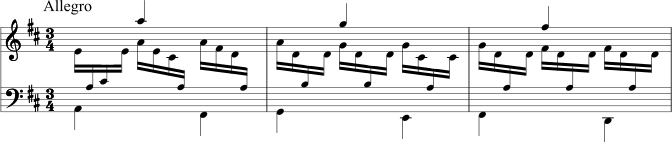
and structurally very similar in Bach's 5th variation: (Example 6)

“But what in Scarlatti is the joy of overcoming daring difficulties, heightened by him to stupendous virtuosity, is here taken more strictly and placed entirely in the service of the musical idea.”[25] Thus Bach does not succumb to the temptation to place a variation entirely in the shadow of a technical problem. In Variation 5, after sections of varying lengths, a new idea emerges as dominant[26]. “Precisely in order to avoid the noticeable monotony found in contemporary variations (Handel!), the differentiation of the time groups is taken further (8-4-4; 4-2-2-2-6).”[27].
The problems posed by composing canons over a fixed bass line can be clearly illustrated by the unison canon (V 3). Here, there are two bass line notes per bar. With the exception of the ninth canon, which is written for two voices, Bach added a free bass to the two canon voices, which can, nevertheless, participate in the imitative process (V 15). Since the following voice in the unison canon repeats the leading voice note for note at a distance of one bar, this inevitably leads to harmonic shifts in relation to the basic structure. At the beginning of the fourth bar, we would expect D major, but instead we find G major, which should only appear in the second half of the bar. This is because in bar 4, the leading voice of bar 3 must be imitated, which back there quite correctly plays around the sixth chord of G major. Conversely, in bar 7, Bach anticipates the cadence (B3–D2–C#2–D2) in the leading voice so that it can be realised in bar 8, in the correct place, through imitation. However, Bach distinguishes between these two cadences: the bass glosses over the first – instead of the dominant note of D major, A, only the leading tone C sharp appears in the flowing sixteenth note movement – and marks the actual cadence with strong eighth notes, which had to be shortened to three eighth notes because of the D major sixth chord carried over from bar 7 to bar 8.
Changing the distance interval also changes the problems involved in composing canons. Normally, the distance interval is upward, meaning that the second voice begins above the first. However, Bach makes two exceptions to this rule in the third and fourth canons (V 9 and V 12). Andreas Traub comments: “Since the canon variations are based on the given harmonic sequence, the fourth of them must be an under-fourth canon, because an over-fourth canon with its structural tendency towards the subdominant range would hardly be suitable for the bass line following the interplay between tonic and dominant.”[28]
Instead of the canon in the tenth expected in the 30th variation, Bach set the quodlibet, “i.e. a combination of various folk melodies, popular in social singing since the 16th century, usually humorous, in which everyone was allowed to sing ‘quod libet’, whatever they liked.”[29] One is inclined to believe Forkel when he reports on the family days of the Bach family of musicians, ‘that they used to begin them with a chorale and end them with a quodlibet.’[30]
The texts for the two melodies[31] used in the Quodlibet were initially passed down to us orally by Bach's pupil Johann Christian Kittel[32]. According to Baensch[33], "the Quodlibet is intended to mediate between the series of variations and the return of the theme: 'I have been away from you for so long,' says the personified theme, 'Kraut und Rüben' (‘cabbage and turnips’, meaning ‘messy odds and ends’, here the 29 variations) 'have driven me away'.”[34] For the sake of readability, I have taken up Busoni's idea[35] and written out the beginning of the Quodlibet in score format: (Example 7)
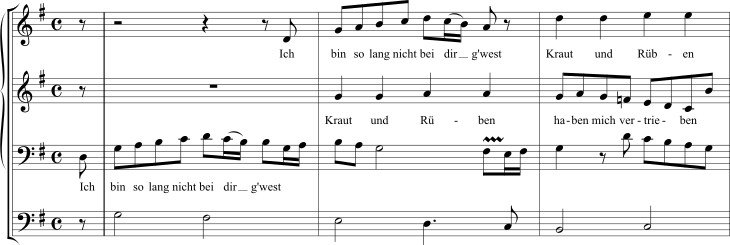
We readily believe that the master could have intended it to be as witty and ingenious as Baensch suggests. Be that as it may, with the Quodlibet Bach has succeeded in creating a surprising and imaginative conclusion to the 30 variations. The return of the aria, which he expressly demands by adding “Aria da capo e fine” at the end of the quodlibet[36], concludes the magnificent cycle of the Goldberg Variations.