The aria, whose bass line forms the basis for the variations, can also be found – without any indication of a composer or title – in the Notenbüchlein für Anna Magdalena Bach (“Notebook for Anna Magdalena Bach”), begun in 1725, among other pieces, most of which were not composed by Johann Sebastian Bach. This raises the question of authorship, on which musicologists' opinions differ greatly. Two contrasting views are presented here as examples. In his foreword to the new edition of the Notenbüchlein, the editor Arnold Schering writes:
„Both the modulation plan and the overly artificial embellishment of the melody raise serious doubts about Bach's authorship. Its later use in his own artistic ‘Veränderungen’ [variations] does not preclude the assumption that the piece originated from another composer, perhaps a friend, and was taken up again by Sebastian years later for some unknown reason (homage).“[9]
However, Andreas Traub takes a completely different view in his book on the Goldberg Variations:
„The fact that the ‘Aria’ also appears in the Notebook for Anna Magdalena Bach, which was begun in 1725, does not suggest an earlier origin. Judging by the handwriting, the entry was not made before 1733, and since the musical text shows only minor deviations from that of the Goldberg Variations, which may be due to hurriedness, it can be assumed that it is a copy of the printed version. Furthermore, it is difficult to imagine that Bach would have based such an important work on a composition that was several years old without revising it. The structure of the ‘Aria’ also refers to the entire work in so many ways that it is hardly conceivable that it could have been composed separately from the overall concept.”[10]
This comparison only needs to be supplemented by the remark that the majority of authors and researchers consider Bach's authorship to be probable.
The beautiful upper voice melody of the aria will not be analysed in detail here.[11] It was not this melody that Bach chose as the basis for his variations, but rather the harmonic progression linked to the sequence of fundamental notes, which, in essence, can be represented as follows: (Example 1):[12]
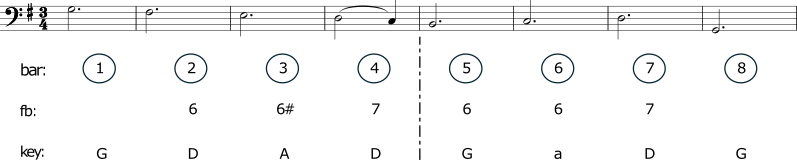
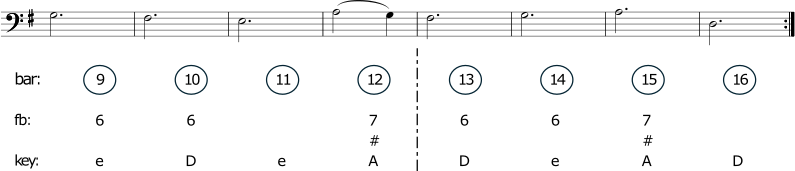
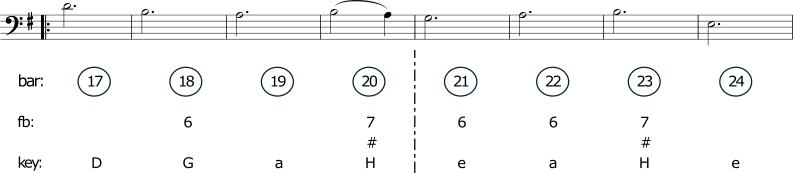
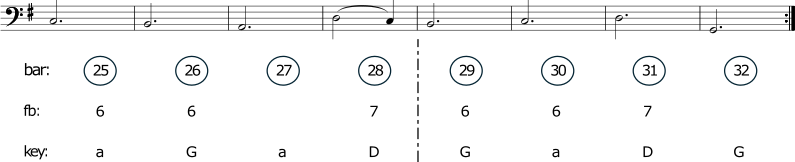
This bass line is clearly structured in four sets of eight bars, each consisting of two groups of four bars. The middle is marked by the cadence to the dominant D major, the end by the return to the tonic G major. The first part of an eight-bar group is always the descending tetrachord or a variation thereof; the second part is always a cadence. This, in turn, can be seen as a free inversion of the descending tetrachord, and the use of further relationships between the bar groups – the basic patterns in bars 5 to 8 and 29 to 32, for example, are identical – justifies the conclusion that the bass line represents a series of variations in itself.
The descending tetrachord (corresponding to bars 1–4) has been documented since the 16th century as a basic formula of ostinato-bound instrumental music.[13] In Baroque music, it often served as the basis for extensive variation works. One example is the descending tetrachord C3–B2–A2–G2, on which Andreas Herbst developed no fewer than a hundred variations in his work Arte prattica e poetica (1653), or Johann Caspar Ferdinand Fischer, whose chaconne from Musicalisches Blumen-Büschlein (1698) varies the descending tetrachord G3-F#3-E3-D3 thirty times.
The descending tetrachord with subsequent cadence (corresponding to bars 1–8) was already the starting point for many variations before Bach. For example, in Purcell (Chaconne in F major Z 335/7 from Sound the Trumpet, Beat the Drum, 1687) or, shortly before Bach, in Handel (Chaconne for piano with 21 variations in G major HWV 435, 1733). The Sarabande with 12 Variations by Johann Sebastian Bach's uncle Johann Christoph Bach is considered a direct precursor to Bach's variations. There, the descending tetrachord with cadence to the dominant is followed by an ascending tetrachord with cadence to the tonic.[14]
Three of the thirty variations are in minor key. In the first four bars, Bach does not choose the simple minor descending tetrachord as used, for example, by Heinrich Ignaz Franz Biber in his Passacaglia in G minor, but rather the so-called “passus duriusculus”, a chromatically descending tetrachord that also has a long and rich history. The G minor lament “When I am laid in earth” from the third act of Henry Purcell's opera Dido and Aeneas (1689), set over an ostinato “passus duriusculus”, is just one of many examples from music history prior to Bach. (Example 2)
